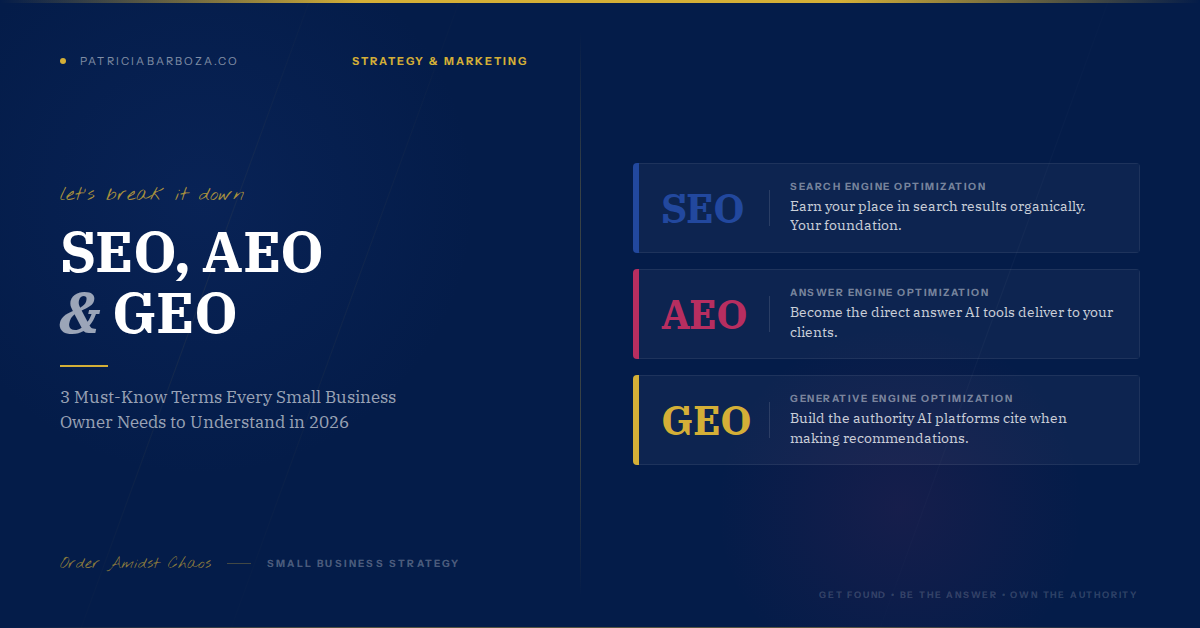
SEO, AEO, and GEO: 3 Must-Know Terms Every Small Business Owner Needs
You built a business. You did not sign up to decode marketing acronyms. Let’s change that.
You opened this post because you saw three acronyms in a headline and thought, “Great. Another thing I need to learn.” Same.
The marketing world loves a good acronym. But here is the truth: SEO, AEO, and GEO are not competing strategies fighting for your attention. They are three layers of the same goal, which is getting your business found by the right people at the right time.
And in 2026, understanding the difference between SEO, AEO, and GEO is not just good marketing knowledge. It is the difference between showing up in search results and being invisible entirely.
Let me break them down in plain English. No jargon. No fluff. Just what you actually need to know.
SEO (Search Engine Optimization) helps your website show up in Google search results. AEO (Answer Engine Optimization) helps your content become the direct answer Google, ChatGPT, or Perplexity delivers to users. GEO (Generative Engine Optimization) helps AI platforms cite your brand as a trusted authority when generating responses. Think of them as three floors of the same building: SEO is the foundation, AEO is the middle floor, and GEO is the penthouse.
Search Engine Optimization
Optimizing your website so it ranks higher in Google search results when people search for what you offer.
Answer Engine Optimization
Structuring your content so AI tools pull it as the direct answer to a user’s question.
Generative Engine Optimization
Building enough authority and presence that AI platforms like ChatGPT cite your brand in their responses.
What Is SEO? (And Why It Still Matters)
SEO is the original. It has been around since the early days of the internet and it is still the most critical foundation for any service-based business online.
When someone types “email marketing for med spas Tampa” into Google, SEO determines whether your website shows up on page one or page ten. It is the difference between being found and being invisible.
How It Works (Simplified)
- 1 Google sends “crawlers” (think digital robots) to read your website and every page on it.
- 2 They evaluate your keywords, page speed, backlinks from other sites, and whether your content actually answers what people are searching for.
- 3 Based on all of that, Google decides where to rank you in search results.
Real-world example: You run a wellness studio in Tampa. SEO means your website includes location-specific phrases like “pilates studio Tampa” or “women’s fitness near me.” It means having a complete Google Business Profile. It means getting listed in local directories. All of that tells Google: “This business is real, it is relevant, and it deserves to be seen.”
According to BrightEdge research, 68% of online experiences begin with a search engine. Your SEO is your first impression before a potential client ever lands on your website.
An email marketing strategy built on SEO-informed content helps you attract the right audience before they even opt in. You write about what they are already searching for, which builds trust and fills your list with people who already want what you offer. That is clarity before strategy in action.
SEO works across all search engines: Google, Bing, Yahoo, DuckDuckGo. Optimizing your site once benefits all of them. SEM is the paid version of that visibility. Think Google Ads or Microsoft Ads, which covers Bing, Yahoo, and DuckDuckGo in one campaign. The simple distinction: SEO = earn your way to the top. SEM = pay your way to the top. Both are valid. For service-based businesses, Microsoft Ads is often overlooked and underpriced. Lower competition, cheaper cost-per-click, and a slightly older, higher-income audience. Worth knowing it exists.
Key takeaway: SEO gets you ranked in search results organically. SEM gets you there immediately, with a budget. Start with SEO. Layer in SEM when you are ready to accelerate.
What Is AEO? (The Part Most Business Owners Are Missing)
AEO is what happens when search engines stop showing a list of links and start delivering the answer directly.
You have seen this. You type a question into Google and instead of ten blue links, you see a box at the top with a direct response. That is an AI Overview. AEO is the practice of structuring your content so that you are the source of that answer.
The same thing happens in ChatGPT, Perplexity, and Google Gemini. When someone asks “what should I include in my email welcome sequence,” those platforms synthesize information from across the web and deliver one clean response. AEO is how you become one of those sources.
Those numbers are not a warning. They are an opportunity. If your content is structured correctly, you show up in the answer itself, not just in the results below it.
How It Works (Simplified)
- 1 Write in a question-and-answer format whenever possible.
- 2 Start key sections with a direct, clear answer (30-60 words) before going deeper.
- 3 Add an FAQ section to your blog posts and service pages.
- 4 Use structured data (schema markup) so search engines understand exactly what your content is about.
Real-world example: You run a bookkeeping business and someone searches “how do I prepare my books for tax season.” AEO means your blog post opens with a direct answer. Not a story about how you got into bookkeeping. Not a disclaimer. The answer first, then the depth. That structure is what gets pulled into AI Overviews and featured snippets.
“SEO helps you rank in Google. AEO helps you be the answer. That’s the shift happening right now.”
Key takeaway: AEO is about being the answer, not just appearing in a list of results.
What Is GEO? (The Newest Layer Every Business Needs to Know)
GEO is the newest term in the conversation and the one most service-based business owners have not heard of yet. But it is coming for all of us, and the sooner you understand it, the better positioned you will be.
If AEO is about showing up in AI answers, GEO is about being cited as the trusted source behind those answers. It is about building enough authority that AI platforms associate your brand with expertise on specific topics.
When someone asks ChatGPT, “Who can help me with email marketing for my salon in Tampa?” GEO is what determines whether your name comes up. Not because you paid for an ad. Because you have built enough credibility, in enough places, that AI recognizes you as the authority.
GEO is quickly becoming essential as AI platforms become the new front door to the internet. Researchers from Princeton and IIT Delhi who coined the term found that content with statistics and expert citations is 30-40% more likely to be referenced by AI systems.
How It Works (Simplified)
- 1 Publish consistent, factual, expert-level content on your topic. Niche down. Own your subject matter.
- 2 Build presence on high-authority platforms: Google Business Profile, industry directories, local news features, podcast appearances, review sites.
- 3 Earn reviews that describe your specific expertise. “She helped me map my entire client journey and fix my email strategy” is more powerful for GEO than “Great service!”
- 4 Link to authoritative sources in your content. AI systems trust sources that connect to other credible sources.
Real-world example: You are a business strategist in Tampa. GEO means that when someone asks an AI tool “who can help me build a marketing strategy for my service business,” your name surfaces. That happens because you have published a consistent body of work, your Google Business Profile is complete, you are listed in directories, you have reviews that describe your exact process, and your website content demonstrates clear authority.
According to HubSpot’s Spring 2026 Spotlight, AI referral traffic to websites has tripled in the past year. It is still a small share of overall traffic, but it is the fastest-growing referral channel businesses have ever seen — and it is only accelerating.
Here is the part that should excite you: GEO levels the playing field. You do not need a big brand budget to build authority. A consistent blog, a complete Google Business Profile, a handful of strong reviews, and expert content on niche topics can position a small service-based business ahead of larger competitors who are not paying attention to this yet.
Key takeaway: GEO is about becoming the authority that AI platforms cite. It is a long game, and the time to start is now.
SEO, AEO, and GEO: How They Work Together
These are not three separate strategies. They build on each other, and you cannot skip the foundation.
Without SEO, your website cannot be found by humans or AI. Without AEO, your content does not get pulled into featured answers or AI Overviews. Without GEO, your brand does not get cited when AI generates recommendations or summaries.
SEO gets you into the room. AEO gets you to the front of the room. GEO makes you the one everyone references when they leave.
The good news: working on one helps the others. A well-written blog post that is optimized for a specific keyword (SEO), opens with a direct answer (AEO), and cites authoritative sources (GEO) checks all three boxes at once. That is not three times the work. That is smart content strategy.
When to Use SEO, AEO, and GEO (A Practical Guide)
This is where most business owners get stuck. You do not have to tackle all three at once. Build the foundation first, then layer up.
Start here if any of these apply to you:
- Your Google Business Profile is incomplete or does not exist
- Your website has little to no written content or a blog
- You are not showing up in local search results at all
- You are not tracking what keywords bring people to your site
Add this layer once:
- You have at least 5-10 blog posts published
- You are ranking for some keywords but not getting clicked
- You want to show up in AI Overviews and featured snippets
- Your service pages exist but are not converting well
Focus here when:
- You are consistently publishing expert content
- You want to be recognized as the go-to in your niche
- You are ready to build presence beyond your website
- You are actively gathering reviews and directory listings
What This Looks Like for Service-Based Businesses Right Now
If you are a coach, consultant, esthetician, med spa owner, salon owner, photographer, or chiropractor, here is what SEO, AEO, and GEO look like in your actual business today:
SEO in action: Your website has a page for each core service. Your Google Business Profile is complete with accurate hours, photos, and a detailed description. You have blog content that uses the specific phrases your ideal clients search for, like “botox for first timers Tampa” or “how to find a business coach for women.”
AEO in action: Your blog posts open with a direct answer to the question in the title. Your service pages have an FAQ section at the bottom. When a potential client Googles the exact problem you solve, your content is the answer they see at the top of the page, before they even have to click.
GEO in action: When someone asks ChatGPT “who are the best email marketing consultants for small businesses in Tampa,” your name is in the response. Because you have published consistent content, maintained a complete online presence, and built a body of work that AI platforms recognize as credible.
This is what “clarity before strategy, strategy before tactics” looks like in your marketing. You do not need to do everything. You need to do the right things in the right order.
If you are not sure where you stand or where to start, that is exactly what the Strategic Growth Blueprint is designed to solve. It maps your current marketing, surfaces the gaps, and builds a clear plan for what to tackle first.
Frequently Asked Questions About SEO, AEO, and GEO
Is SEO dead now that AI search exists?
No. SEO is the foundation of everything. AEO and GEO are built on top of it, not instead of it. Google is still processing over 14 billion searches per day. Your SEO is not optional. It is just evolving.
Do I need to do all three right now?
Start with SEO. Add AEO once your content strategy is in place. Layer in GEO as your authority and publishing consistency grows. Think of it as building a house: you do not install the roof before laying the foundation.
Does email marketing help with SEO, AEO, or GEO?
Yes to all three. Your email list drives consistent traffic back to your blog, which is a positive SEO signal. Your newsletters can be repurposed into answer-rich blog content for AEO. And consistent, valuable email content builds your reputation as a subject matter expert over time, which supports your GEO authority.
How long does it take to see results from each strategy?
SEO typically shows movement in 3-6 months. AEO can produce results faster when your content structure is right. GEO is the longest game, often 6-12 months of consistent publishing and presence-building before you see measurable authority signals.
What is the one thing I can do today to improve all three?
Publish one well-researched, question-based blog post. Give it a keyword-rich title (SEO). Open with a direct 50-word answer (AEO). Cite two or three authoritative sources and back your claims with data (GEO). One post, three layers, done.
Know Your Marketing Before You Scale It
The Strategic Growth Blueprint gives you a clear, research-backed picture of where your marketing stands and what to do next. No guessing. No overwhelm. Just order amidst the chaos.
Patricia Barboza is a small business strategist and done-for-you email marketing consultant based in Tampa, Florida. She works with women-owned service businesses to build clear, scalable marketing strategy. Subscribe to Walking the Talk, her weekly newsletter, for insights like this every week.