Best Email Marketing Platform for Service Businesses (2026)
The most common question I get from service-based business owners, and the honest answer that most people aren’t giving you.
Choosing the right email marketing platform is one of the most common questions I get from service-based business owners. And my honest answer isn’t a platform name.
It’s this: the best email marketing platform for your business is the one that works with how your business actually runs.
I know that’s not the definitive list you were hoping for. But choosing an email marketing platform based on someone’s recommendation in a Facebook group, or because a competitor uses it, is exactly how you end up managing two systems, manually re-uploading your list every month, and wondering why nothing feels connected.
Strategy before tactics. That applies here too.
Start With Integration, Not Features
If your business runs on a booking or CRM platform, that’s your starting point. Not your inbox provider’s feature list.
Here’s why this matters. Every time a client books, rebooks, shows up, or cancels, that data lives in your CRM or booking software. If your email marketing platform doesn’t connect to that system, you have two separate sources of truth. Keeping them in sync becomes a manual job, and a manual job means it won’t get done consistently.
The most efficient email marketing setup is the one where your booking data and your email platform are already talking to each other.
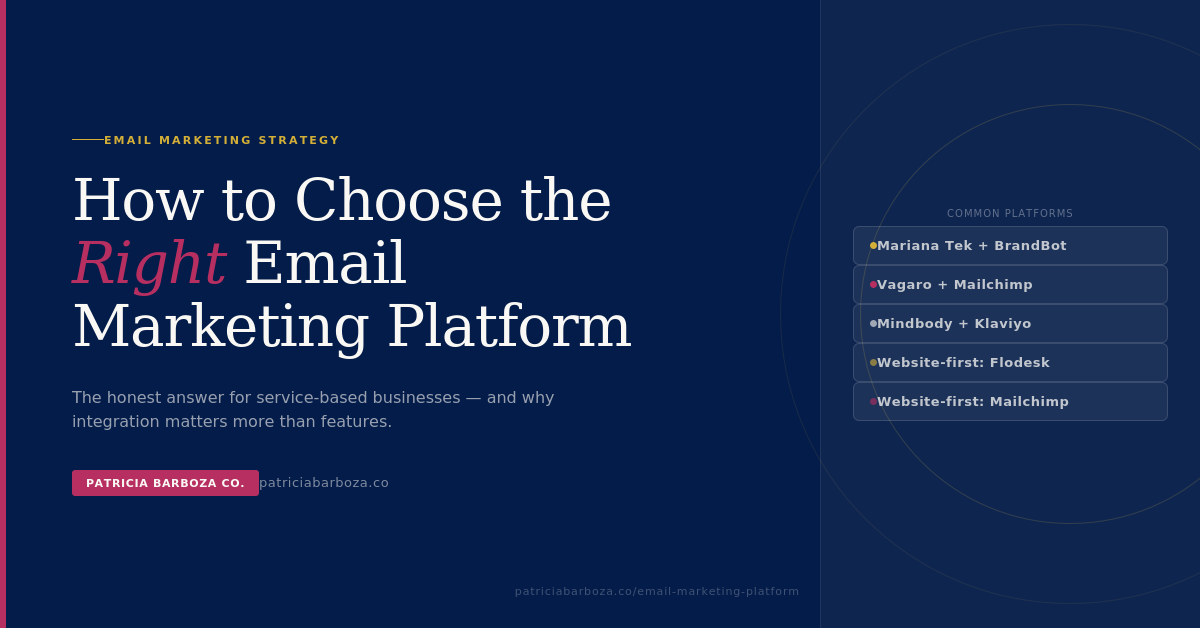
Start with the software you’re already living in, and work backward to what integrates well. Here’s how that looks in practice for some of the most common platforms among wellness and service-based businesses:
Does Your Booking Platform Already Include Email?
Before you go shopping for a separate email platform, it’s worth asking a question that a lot of business owners skip: does the software you’re already paying for have email marketing built in?
The answer is probably yes, at least at a basic level. Mindbody includes email and SMS marketing on its higher-tier plans. Vagaro has built-in email campaigns. These tools aren’t always marketed front and center, but they exist.
For some businesses, that built-in functionality is genuinely enough. If you’re sending a monthly newsletter, running occasional promotions, and setting up a welcome sequence, the tools already inside your booking platform may cover it without adding another subscription.
The question worth asking is: have you outgrown it?
Your platform’s email capabilities are a starting point, not a ceiling.
You’ve likely outgrown your built-in email tools if you can’t segment beyond basic filters, if there’s no way to trigger automations based on specific behaviors, if your reporting doesn’t distinguish between real opens and machine opens from MPP, or if you’re finding yourself manually managing lists that should update automatically. When the tool stops doing what you need, that’s the right time to look outside it, not before.
This matters because adding a second platform too early creates the exact problem integration is supposed to solve. Two systems, two lists, two places to update things. Get real mileage out of what you have first. Then upgrade intentionally when the functionality genuinely doesn’t match where your business is.
Not Everyone Needs HubSpot or GoHighLevel
Let’s talk about the elephant in the room.
HubSpot and GoHighLevel are powerful. That’s not in question. They’re robust CRM-plus-marketing suites designed for businesses with dedicated sales teams, complex multi-stage pipelines, and the operational infrastructure to actually use what they’re paying for.
Most solo service providers use about 20% of what these platforms offer.
Before you invest in either platform, ask yourself: do I have the team and the processes to actually leverage what I’m paying for? If the answer is no, a simpler platform will serve you better and cost you significantly less every month.
This isn’t a knock on either platform. If your business genuinely needs that level of sophistication, they can absolutely deliver. But for the majority of med spas, studios, salons, and solo practitioners I work with, the cost-to-utility ratio doesn’t pencil out at this stage of the business. Get the right tool for where you are now, not where you hope to be in five years.
What to Look For in Any Email Marketing Platform
Regardless of which email marketing platform you land on, these are the capabilities that should guide your decision.
- Segmentation and automationsThis is where you get your time back. The ability to sort your list by behavior, purchase history, or engagement level — and trigger automated sequences based on those segments — is what separates a list from an actual marketing asset.
- Accurate engagement data (MPP-aware)Apple’s Mail Privacy Protection means open rates are no longer reliable as a standalone metric. Look for a platform that flags or filters machine opens so your engagement data reflects actual human behavior.
- Integration with your main traffic sourceWhether that’s your booking CRM, your website, or your landing page tool, the platform needs to connect in a way that’s meaningful — one that allows you to act on behavior, not just sync contacts.
- DeliverabilityThe platform you choose affects whether your emails actually land in inboxes. Google publishes its bulk sender requirements — the platforms worth using are already built to meet them.
These aren’t bonus features. They’re the foundation.
If the platform you’re considering doesn’t offer segmentation, automation, clean engagement tracking, and solid deliverability, it’s not the right tool — no matter how pretty the email templates are or how much you saw it recommended online.
The Bottom Line
There is no single best email marketing platform. There’s the one that fits where your business is right now, connects to the tools you already use, and gives you data you can actually act on.
The businesses I see getting the most out of their email marketing aren’t necessarily using the most sophisticated tools. They’re using the right tool for their model, set up in a way that runs consistently without requiring constant manual maintenance.
If you’re unsure which category your business falls into, or you’re trying to figure out what you actually need before you invest in a platform, that’s exactly the kind of clarity work I do. You can start with the Clarity Report, or if you’re ready to look at your full marketing strategy, the Strategic Growth Blueprint is where we dig into all of it.
And if you already know you want someone to handle the email side for you, the Done-for-You Email Marketing packages are built for service-based businesses exactly like yours.
Frequently Asked Questions
What is the best email marketing platform for small businesses?
There is no single best email marketing platform for every small business. The right choice depends on what booking or CRM software you already use, how your clients find and book you, and what level of automation you need. For businesses on Mariana Tek, BrandBot is a strong match. For Vagaro users, Mailchimp and Constant Contact both offer integrations. For website-first service businesses, Flodesk and Kit are worth exploring.
Do I need HubSpot or GoHighLevel for my service business?
Most solo service providers and small wellness businesses don’t need HubSpot or GoHighLevel. Both platforms are designed for businesses with dedicated sales teams, complex pipelines, and the operational infrastructure to use them fully. A simpler, better-integrated platform will often serve you better at a fraction of the cost.
What is Apple Mail Privacy Protection and how does it affect my email marketing?
Apple Mail Privacy Protection (MPP) pre-loads email tracking pixels, causing emails to register as “opened” whether the recipient actually read them or not. This inflates open rate data. When choosing an email platform, look for one that identifies and filters these machine-generated opens so your engagement data reflects actual human behavior.
What features should I look for in an email marketing platform?
For service-based businesses, the three non-negotiables are: (1) segmentation and automations; (2) accurate engagement tracking that accounts for Mail Privacy Protection; and (3) meaningful integration with your main traffic or booking source.
What email platform works with Mariana Tek?
BrandBot has a native integration with Mariana Tek and is purpose-built for fitness studios and wellness businesses. If your business runs on Mariana Tek, BrandBot is the first platform worth evaluating before comparing other options.
Do I need a separate email platform if my booking software already has email built in?
Not necessarily. Many booking platforms have built-in email and SMS marketing tools. For businesses sending a monthly newsletter and basic automations, that may be enough. Signs you’ve outgrown it: you can’t segment beyond basic filters, there’s no way to trigger behavior-based automations, or you’re manually managing lists that should update themselves.
Is Klaviyo good for wellness businesses?
Yes. Klaviyo for Wellness connects natively with Mindbody, Zenoti, and Boulevard. It syncs appointments, classes, memberships, and purchases so you can build behavior-based automations from your actual booking data. It has a steeper learning curve than simpler tools, but for a wellness business ready to do serious email and SMS automation, it’s one of the most powerful options available.
What is the difference between Flodesk, Kit, Mailchimp, and MailerLite?
All four work well for service-based businesses whose main traffic driver is a website. Flodesk charges a flat monthly rate regardless of list size. Kit is built for creators and service providers who want clean automations. Mailchimp has the largest integration library and a free entry tier. MailerLite offers a balance of simplicity and automation depth at a lower price point. The right choice depends on your list size, budget, and automation needs.
What email platform works with Vagaro?
Both Mailchimp and Constant Contact have integrations with Vagaro. The depth of integration varies by plan level, so it’s worth checking each platform’s current integration documentation against your specific Vagaro setup before committing.